How to Paraphrase Without Plagiarizing: 7 Simple Steps
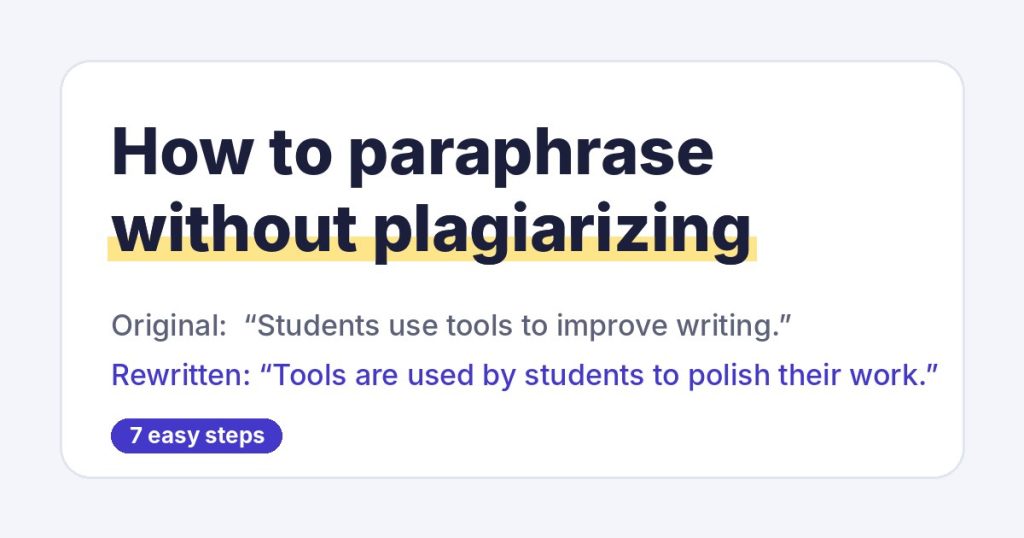
Paraphrasing means expressing someone else’s idea in your own words. Done well, it shows you truly understand a source. Done badly, it can look like plagiarism, even when you did not mean to copy. Here is a simple, reliable method you can use for essays, assignments and blog posts.
What is paraphrasing?
To paraphrase is to restate an idea using different words and a different sentence structure while keeping the original meaning. A good paraphrase is usually about the same length as the original. It is different from a summary, which is shorter and covers only the main points, and from a quotation, which repeats the exact words inside quotation marks.
Why paraphrasing matters
- It proves you understand the source rather than just copying it.
- It lets your own writing voice stay consistent throughout your work.
- It helps you combine ideas from several sources smoothly.
- Most teachers prefer paraphrasing to long quotations.
How to paraphrase in 7 simple steps
- Read the original until you understand it. Read the passage two or three times. Look up any words you do not know. You cannot rewrite an idea you have not understood.
- Close the source and write from memory. Put the original away and explain the idea as if you were telling a friend. This is the easiest way to avoid copying the original sentence pattern.
- Change the sentence structure. Move clauses around, split a long sentence into two, or combine short ones. You can also switch between active and passive voice: “Researchers found a link” can become “A link was found by researchers.”
- Use your own vocabulary. Replace words with natural synonyms, but do not force rare words. Keep technical terms, names, numbers and formulas exactly as they are.
- Compare with the original. Check that the meaning is identical and that you have not kept long strings of the same words. If three or more words in a row are identical and distinctive, rewrite them or use quotation marks.
- Cite the source. A paraphrase still uses someone else’s idea, so it needs a citation. Use our free citation generator to create APA, MLA, Chicago or Harvard references.
- Proofread. Read your paraphrase aloud and fix any grammar slips. Our grammar checker can help you catch small mistakes.
A paraphrasing example
Original: “Regular exercise improves both physical and mental health, and doctors recommend at least 150 minutes of moderate activity every week.”
Poor paraphrase (too close): “Regular exercise improves physical and mental health, and doctors suggest at least 150 minutes of moderate activity each week.”
Good paraphrase: “Doctors advise people to do at least 150 minutes of moderate activity each week, since staying active benefits the body as well as the mind.”
The good version changes the order of ideas, the sentence structure and most of the wording, but the meaning and the number stay exactly the same.
Common paraphrasing mistakes
- Only swapping synonyms while keeping the same sentence pattern (often called “patchwriting”).
- Changing the meaning, for example making a claim stronger or weaker than the original.
- Changing facts or numbers, such as dates, percentages or formulas.
- Forgetting the citation because the words are now your own.
Can a paraphrasing tool help?
Yes, as long as you use it as a helper, not a replacement for your own thinking. Our free paraphrasing tool suggests new wording and sentence structures, lets you freeze words that must not change, and highlights every edit so you can review it. Always read the result, check it against the source and add your citation.
Frequently asked questions
Is paraphrasing plagiarism?
No, not when it is done correctly and the original source is cited. Paraphrasing without a citation, or staying too close to the original wording, can count as plagiarism.
How much should I change when paraphrasing?
Change both the wording and the sentence structure. There is no exact percentage, but the result should read as your own writing while keeping the original meaning.
Do I need to cite a paraphrase?
Yes. Whenever you use another person’s idea, research or argument, cite it, even if every word is your own.
What is the difference between paraphrasing and summarizing?
A paraphrase restates one passage in full and is about the same length. A summary is shorter and covers only the main points of a longer text. Try our summarizer for that.